Article
There’s a silent killer destroying marketing performance inside organizations.
There’s a silent killer destroying marketing performance inside organizations.
Article
The silent killer of marketing is staring us all in the face.
Most organizations do not wake up one day and suddenly decide their marketing is failing.
The realization usually arrives slowly.
Return on ad spend begins to soften. Sales teams no longer feel fully supported. Social engagement appears healthy, yet revenue remains stagnant. Sponsorships generate visibility without producing meaningful business impact. Creative departments stay busy while leadership grows increasingly frustrated by the lack of momentum.
Eventually, the conversation turns toward marketing itself.
The assumption becomes that the organization needs better campaigns, more content, more advertising, or a stronger social media presence.
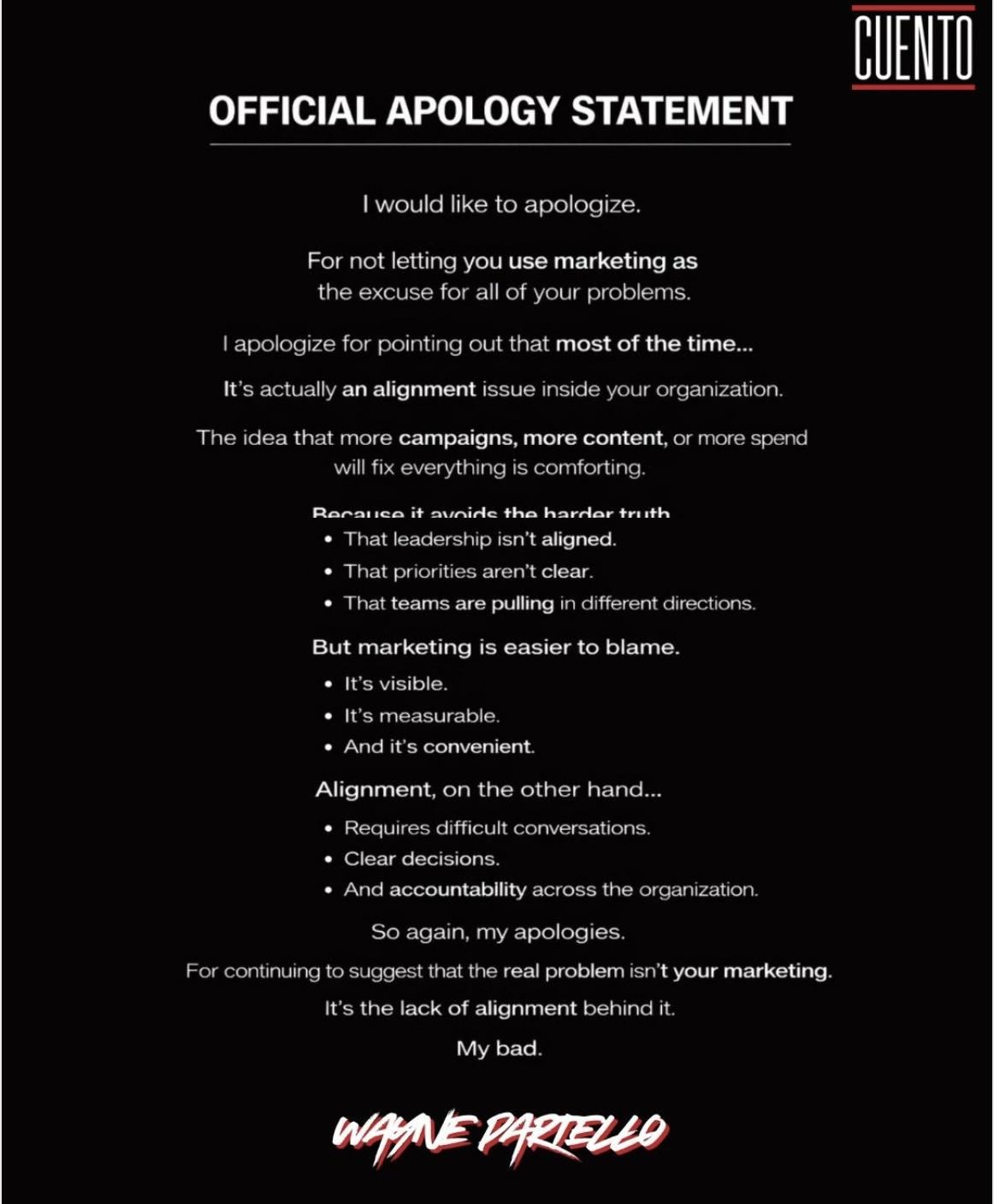
But in many cases, the issue is not marketing.
It is alignment.
Across sports, entertainment, live events, and enterprise organizations, one pattern appears repeatedly:
Disconnected organizations produce disconnected results.
The brand team communicates one vision while the sales team communicates another. Advertising promises an experience that operations cannot consistently deliver. Social media pursues relevance and trends that have little connection to long-term positioning. Leadership aspires to premium perception while internal systems and customer experiences remain average.
None of this is typically caused by a lack of effort.
In fact, most struggling organizations are filled with talented people doing genuinely good work.
The issue is that those efforts are often moving in different directions.
This is one of the biggest patterns we uncover when assessing organizations at CUENTO (opens the CUENTO site in a new tab). Most teams are not lacking activity. They are lacking clarity and alignment around where the organization is trying to go and how every department contributes to getting there.
When alignment breaks down, marketing begins losing its strategic foundation.
Campaigns become less clear. Content loses purpose. Departments become reactive instead of collaborative. Teams optimize for themselves instead of the larger organization.
Over time, marketing stops feeling intentional.
It starts feeling noisy.
Alignment creates efficiencies for all verticals.
Once leadership begins to feel that marketing is underperforming, the response is often predictable.
Organizations start chasing tactics.
More content. More ads. More platforms. More trends. More urgency.
But tactical volume rarely solves strategic misalignment.
In many cases, it accelerates the problem.
Organizations operating without clarity tend to shift into reactive decision-making. Teams begin working in constant rush mode. Campaigns are pushed out before they are fully developed. Creative becomes diluted through fear-driven revisions and rushed approvals. Leadership starts prioritizing immediate relief over long-term positioning.
Ironically, the faster organizations move under these conditions, the more disconnected they often become.
I have seen organizations spend enormous amounts of money trying to market their way out of problems that were actually rooted in leadership alignment, operational consistency, customer experience, or organizational clarity.
Fear creates reaction.
Confidence creates strategy.
Leaders making decisions from a position of fear often become obsessed with short-term indicators. They chase competitors, overreact to temporary market shifts, force trends into their brand, and constantly change direction in pursuit of immediate results.
The organization may appear active, but activity without strategic cohesion rarely creates sustainable momentum.
Strong organizations operate differently.
Effective leaders establish alignment first. They create clarity around who the organization serves, what it stands for, and what type of experience it intends to deliver.
From there, decisions become easier because every action can be evaluated against a larger strategic direction.
The question shifts from:
“What tactic should we try next?”
To:
“Does this decision move us closer to the experience, perception, and business outcome we are trying to create?”
That distinction changes everything.
The challenge has become even more complicated because consumer expectations evolved faster than most organizations adapted.
Audiences today expect:
Advertising alone is no longer enough.
Consumers increasingly gravitate toward experiences that earn attention rather than simply demand it.
Sports provides one of the clearest examples of this shift. Teams are no longer competing solely against one another. They are competing against streaming platforms, creators, gaming, concerts, restaurants, travel, and every other form of modern entertainment competing for time and attention.
The same dynamic exists in enterprise business.
Attention has become one of the most valuable commodities in the marketplace, yet many organizations still operate as though distribution alone guarantees relevance.
At the same time, expectations placed on marketing departments have expanded dramatically.
Organizations frequently expect a small internal team to function as a fully integrated media company capable of handling:
Modern marketing is no longer a single function.
It is an ecosystem.
The organizations succeeding today understand something many others still underestimate:
Marketing is not simply a department within the business.
It is the connective tissue of the business itself.
Brand influences sales. Experience influences retention. Leadership influences trust. Operations influence reputation. Content influences perception.
Everything communicates.
Which means everything contributes to marketing.
This is why alignment matters more now than ever before.
When organizations align around:
…execution becomes faster and more effective.
Decision-making improves. Teams collaborate more naturally. Marketing becomes more efficient. Organizations operate with greater confidence and consistency.
Not because people suddenly started working harder.
But because the organization finally started moving in the same direction.
The organizations that succeed over the next decade will not necessarily be the loudest.
They will be the most aligned.
Experienced By Wayne: The Newsletter
Ideas, observations and lessons from the intersection of business, marketing, sports and experience. Delivered to your inbox.
Article
There’s a silent killer destroying marketing performance inside organizations.
Observation
If this looks familiar…
Observation
It’s been a long month.
Observation
I’ll say it again.